
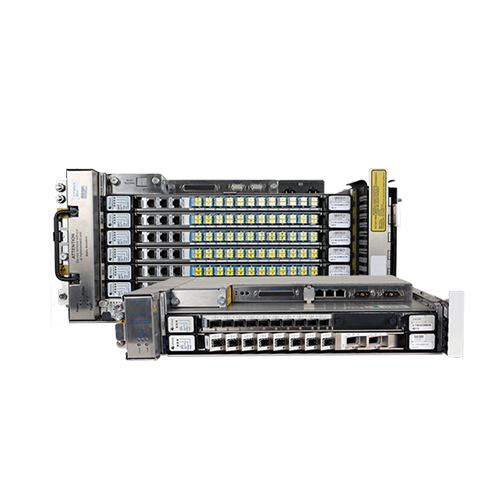
The Tellabs 7100 Optical Transport System is a high-capacity, carrier-class DWDM platform designed to meet the growing bandwidth demands of service providers, data centers, and large enterprise networks. Engineered for scalability, flexibility, and efficiency, the 7100 series enables seamless transport of voice, video, and data services across metro, regional, and long-haul optical networks.
With support for a wide range of optical interfaces and advanced features such as ROADM (Reconfigurable Optical Add/Drop Multiplexing), integrated optical switching, and intelligent network management, the Tellabs 7100 delivers the performance and adaptability required for next-generation transport architectures. Its modular design allows for cost-effective deployment and expansion, while maintaining high reliability and operational simplicity.
Whether you’re upgrading legacy infrastructure or building out a new high-speed backbone, the Tellabs 7100 provides a future-ready solution that aligns with the evolving demands of modern network environments.
Maximum Transmission Capacity: Delivers 400 Gbit/s per fiber, enabling dense data transport.
Extended Reach: Facilitates long-haul networking up to 2500 km with advanced error correction and amplification.
Modularity: Offers flexible configurations from 1 to 40 channels in the C band to suit various network needs.
Sophisticated Optical Control: Includes dynamic gain and output power adjustments, spectral gain control, and end-to-end preemphasis for optimal performance.
Integrated Optical Performance Analyzer: Provides an optional tool for enhanced monitoring and management.
Fiber Type Flexibility: Supports multiple fiber types including SSMF, NZDSF, and DSF.
Service Flexibility: Accommodates a broad range of traffic requirements, from SDH/SONET to IP/ATM.
Tunable Lasers: Simplifies wavelength adjustments and network expansion without the need for swapping plug-in cards.
The Tellabs 7100 is a flexible, high-capacity optical transport system designed to deliver voice, video, and data services over dense wavelength division multiplexing (DWDM) and coarse wavelength division multiplexing (CWDM) networks. It is suited for metro and long-haul networks, supporting next-generation packet-based services alongside legacy TDM traffic.
Chassis Options
The system supports 12-slot or 14-slot modular chassis configurations with redundant fan trays and power supplies. The midplane design allows for hot-swapping of modules.
Transmission Capacities
The Tellabs 7100 supports 10 Gbps and 40 Gbps transponders and can be upgraded to 100 Gbps in some configurations. Up to 88 DWDM channels can be used per fiber with 100 GHz spacing, supporting up to 1 Tbps per chassis depending on the configuration.
Supported Interfaces
Interfaces include Ethernet (1GbE, 10GbE, 40GbE), SONET/SDH (OC-3/12/48/192, STM-1/4/16/64), Fibre Channel (1G/2G/4G), and Video (SDI/ASI over fiber).
Protocols and Standards
Supported protocols include SONET/SDH, Ethernet, OTN (G.709), GFP, LAPS. Complies with ITU-T G.694.1 (DWDM grid) and supports G.652/655 fiber types.
Common Modules
SPM (System Processor Module)
Responsible for chassis control and management, running embedded operating systems and routing functions. Redundant configurations are supported.
Transponder Modules
These modules convert client signals to line optics, such as 10G MRTM-E and 40G transponders, with support for tunable XFP and XENPAK optics.
ROADM Modules
Allow specific DWDM wavelengths to be added or dropped without manual patching. Newer versions offer directionless and colorless capabilities.
Optical Amplifiers
Use EDFA modules to compensate for span loss. Includes mid-span and preamplifier options.
Optical Mux/Demux
Passive components that combine or split DWDM signals. Typically housed in patch panel modules.
Power and Cooling
The system supports dual -48V DC power feeds and hot-swappable power supply units. Integrated fan trays are supported with monitored air baffles for efficient cooling.
Network Management
Managed using the Tellabs 8000 Intelligent Network Manager, which provides real-time monitoring, fault management, optical performance analytics, and secure access via SNMP, TL1, or XML interfaces.
Typical Use Cases
Common deployments include metro core and regional networks, enterprise data center interconnects, mobile backhaul and fronthaul, carrier Ethernet transport, disaster recovery links, and media/broadcast optical transport.
End-of-Life and Replacement
The Tellabs 7100 platform is no longer in production but is still widely used. Refurbished modules and ongoing support services are available through telecom resellers such as Carritech and Genesis Telecom.
From expert maintenance and repair to reliable part sourcing and technical consultation, we provide comprehensive support for every stage of your network’s lifecycle. Whether you’re extending the life of legacy systems or integrating with modern infrastructure, our team ensures seamless, efficient, and cost-effective solutions—so you can focus on performance, not problems.